
Aerospace Controls Laboratory



Yixuan (Lucas) Jia , Mason Peterson , Andy Li
Global data association is an essential prerequisite for robot operation in environments seen at different times or by different robots. Repetitive or symmetric data creates significant challenges for existing methods, which typically rely on maximum likelihood estimation or maximum consensus to produce a single set of associations. However, in these ambiguous scenarios, the distribution of solutions to global data association problems is often highly multimodal, and such single-solution approaches frequently fail. In this work, we introduce a data association framework that leverages approx- imate Bayesian inference to capture multiple solution modes to the data association problem, thereby avoiding premature commitment to a single solution under ambiguity. Our approach represents hypothetical solutions as particles that evolve via deterministic or randomized updates, naturally parallelizable on GPUs, to cover the modes of the underlying solution distribution. Simulated and real-world experiments with highly ambiguous data show that our method correctly estimates the distribution over transformations when registering point clouds or object maps. Code is available at: Link.
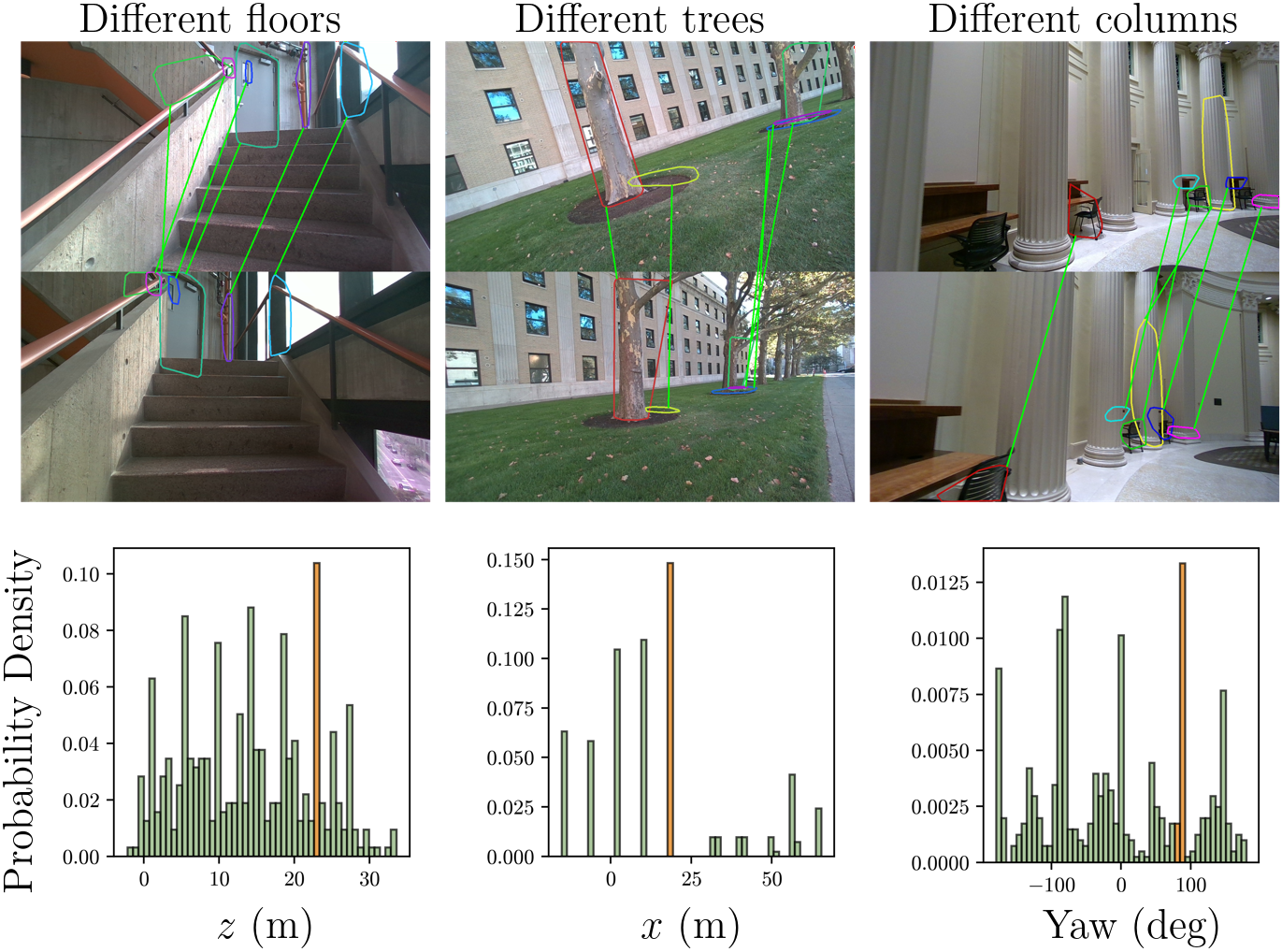 Symmetric and repetitive structures are common in human
environments and induce perceptual aliasing. To localize, robots
must explicitly model the uncertainty from ambiguities inherent
in those environments. The top row shows several such scenarios,
where the visualized object associations are perceptually similar
but incorrect, necessitating a multimodal representation. The bottom
row shows the multimodal distribution generated by our proposed
method. The orange mode is incorrect and corresponds to the
ambiguous associations shown in the top row.
Symmetric and repetitive structures are common in human
environments and induce perceptual aliasing. To localize, robots
must explicitly model the uncertainty from ambiguities inherent
in those environments. The top row shows several such scenarios,
where the visualized object associations are perceptually similar
but incorrect, necessitating a multimodal representation. The bottom
row shows the multimodal distribution generated by our proposed
method. The orange mode is incorrect and corresponds to the
ambiguous associations shown in the top row.